What Is Injection Stretch Blow Molding (ISBM)?
Injection Stretch Blow Molding (ISBM) is an advanced thermoplastic conversion process engineered to produce high-precision hollow plastic containers — including bottles, jars, and pharmaceutical vials — with exceptional clarity, dimensional consistency, and structural strength. It merges injection molding and stretch blow molding into a single, streamlined workflow, making it one of the most efficient container manufacturing technologies available today.
Unlike conventional extrusion blow molding (EBM), the ISBM process begins with a precision-injected preform, giving manufacturers full control over neck finish dimensions, wall thickness distribution, and material weight from the very first stage. The subsequent biaxial stretching phase then orients the polymer chains in both axial and radial directions, fundamentally improving the mechanical and barrier properties of the finished container.
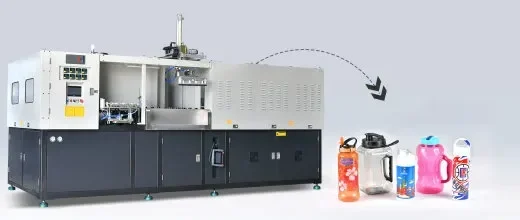
ISBM technology has rapidly become the industry standard for PET bottle production across food & beverage, pharmaceutical, cosmetic, and personal care sectors. Its market dominance is reflected in the numbers: the injection stretch segment currently accounts for over 52% of the global plastic blow molding machine market by revenue — a position driven by relentless demand for lightweight, recyclable, and visually premium packaging.
(Injection Stretch Segment)
(Single-Stage vs Multi-Stage)
(Container Volume)
Core Process Principle
2.1 Biaxial Orientation — The Science Behind the Strength
The defining advantage of the ISBM process lies in biaxial molecular orientation. During conventional molding, polymer molecules remain in a relatively random, amorphous arrangement — leaving microscopic voids between them and limiting mechanical performance.
Round molecules with large air gaps → weak barrier, low strength
Cross-shaped molecules lock together → exceptional barrier & impact strength
By first stretching the preform axially (vertical) with a mechanical stretch rod, then radially (horizontal) with high-pressure air, the ISBM process aligns polymer chains in both directions simultaneously. This cross-linked molecular architecture results in containers with outstanding tensile strength, superior gas barrier properties (critical for carbonated beverages), excellent optical clarity, and significantly reduced material weight.
2.2 Single-Stage vs Two-Stage ISBM Process
| Feature | Single-Stage ISBM | Two-Stage ISBM |
|---|---|---|
| Workflow | Injection + Blow in one machine | Preform produced separately, blown later |
| Energy Use | ✅ Uses residual heat — ~30% lower consumption | Requires secondary reheating of preforms |
| Footprint | ✅ Compact — single machine | Larger — multiple machines required |
| Best For | Small/medium batches, specialty packaging | Massive-scale PET bottle production |
| Preform Flexibility | Preform made in-house | ✅ Can source preforms externally |
The 3-station single-stage machine eliminates the reheat stage entirely, using latent heat retained in the preform — delivering both a 25% reduction in tooling cost and substantial energy savings over the 4-station alternative.
Four Core Process Stages of ISBM
The ISBM process is divided into four sequential, tightly integrated production stages. Each stage is precision-controlled to ensure the final container meets the exact specification demanded by food, pharmaceutical, or cosmetic packaging standards.
Key Machine Components
An ISBM machine is an integrated system of precision subsystems working in synchronized harmony. Understanding each component is essential for optimizing machine performance, minimizing downtime, and achieving consistent container quality at scale.
Injection Molding Unit
Comprises the hopper, barrel, screw, and injection nozzle. Converts plastic resin granules into a homogeneous melt and delivers it under controlled pressure into the preform mold. Screw design is matched to the target resin’s rheological properties.
Preform Conditioning System
Multi-zone heating/cooling infrastructure that manages preform temperature to within ±1°C. In single-stage systems, this leverages residual heat from injection; in two-stage systems, infrared lamp banks provide precise reheat profiling.
Stretch Blow Molding Unit
Houses the stretch rod mechanism, blow valve block, and blow mold clamping assembly. The stretch rod is servo-driven for precise stroke control. High-pressure air circuits provide pre-blow (low pressure) and main blow (high pressure) phases.
Mold Clamping System
Provides the locking force to hold preform and blow molds closed against injection and blow pressures. Servo-electric and hydraulic toggle systems offer different performance profiles for high-speed and precision applications respectively.
PLC Control & HMI
Central PLC manages all machine axes, temperature zones, timing sequences, and safety interlocks. Touch-screen HMI allows operators to adjust process parameters, store recipes, monitor live production data, and diagnose alarms in real time.
Mold Cooling System
Chilled water circuits integrated into the blow mold base and cavity panels. Coolant temperature and flow rate are independently regulated per mold zone to ensure even solidification and consistent container wall geometry.
Compatible Materials & Applications
ISBM machines support a broad range of thermoplastic resins. Material selection governs the final container’s clarity, impact resistance, chemical compatibility, temperature tolerance, and regulatory compliance (food-grade, pharmaceutical-grade, etc.).
| Resin | Key Properties | Typical Applications | Volume Range |
|---|---|---|---|
| PET | Crystal clarity, excellent gas barrier, lightweight, recyclable | Beverage bottles, water, CSD, edible oil | 50ml – 5L |
| PP | Chemical resistance, heat tolerance, FDA-compliant grades available | Hot-fill packaging, household chemicals, food jars | 5ml – 1L |
| PC | High impact strength, optical clarity, temperature resistance | Medical devices, water dispensers, safety containers | 1ml – 500ml |
| PETG / Tritan | BPA-free, crystal clarity, impact resistance, dishwasher-safe | Premium cosmetics, baby products, sports bottles | 10ml – 1L |
| PPSU | Autoclave-sterilizable, extreme temperature resistance, high clarity | Medical/surgical instruments, laboratory containers | 1ml – 250ml |
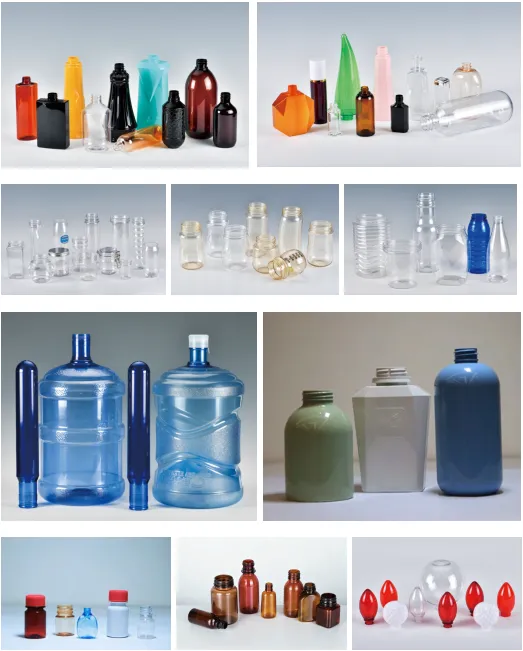
Industry Applications
Core Advantages of ISBM Technology
Energy Efficiency
Single-stage ISBM machines utilize residual heat from the injection stage, eliminating secondary reheating. This integrated approach delivers approximately 30% lower power consumption compared to multi-stage systems, reducing both operating costs and carbon footprint.
Precision Neck Finish
Because the bottle neck is formed first by injection molding, ISBM delivers micron-level dimensional accuracy on thread profiles, sealing surfaces, and opening diameters — critical for tamper-evident caps, pharmaceutical closures, and precision dispensing systems.
Superior Barrier Properties
Biaxial orientation significantly reduces the permeability of PET and PP containers to oxygen, CO₂, and moisture — extending product shelf life and preserving the freshness and carbonation of beverages without requiring additional barrier coatings.
High Automation
Servo-driven axes, PLC process control, and integrated robotics minimize human intervention across the entire production cycle. One operator can efficiently supervise multiple ISBM machines simultaneously, reducing labor costs and improving production consistency.
Sustainable Production
The stretching process optimizes material distribution across the container wall, allowing manufacturers to achieve target mechanical properties with less resin. This lightweight design approach reduces raw material consumption, transport weight, and facilitates end-of-life recyclability.
Design Flexibility
From 1ml medical vials to 1000ml cosmetic jars, ISBM accommodates an exceptionally wide range of container geometries, neck sizes, and design styles. Quick-change tooling systems enable efficient SKU changeovers for brand-specific customization.
Common Defects & Quality Control
Understanding common ISBM process defects — and their root causes — is essential for maintaining zero-defect production. The table below maps the most frequently encountered quality issues to their diagnostic causes and practical corrective actions.
| Defect Type | Root Cause | Corrective Action | Risk Level |
|---|---|---|---|
| Uneven Wall Thickness | Non-uniform preform temperature distribution | Calibrate multi-zone temperature control system; check heating lamp uniformity | High |
| Warping / Deformation | Insufficient cooling time or uneven mold cooling | Increase cooling cycle time; verify mold cooling water flow and temperature per zone | Medium |
| Short Shot (Incomplete Fill) | Insufficient injection pressure or low melt temperature | Increase injection pressure and/or barrel temperature; verify nozzle is not partially blocked | High |
| Haze / Cloudiness | Moisture-contaminated resin or abnormal melt temperature | Ensure resin is properly dried before processing (PET moisture < 30 ppm); check barrel temp profile | Medium |
| Sink Marks | Insufficient packing pressure during injection stage | Increase holding pressure and holding time; review gate size | Medium |
| Residual Stress Cracking | Excessive stretch ratio or incorrect blow timing | Optimize stretch rod speed and pre-blow / main blow pressure timing sequence | Low-Medium |
ISBM vs IBM vs EBM: Technology Comparison
Selecting the right blow molding technology requires understanding the fundamental trade-offs between process types. The comparison below helps engineers and procurement managers identify the optimal approach for their specific application.
| Parametre | ISBM Injection Stretch Blow |
IBM Injection Blow |
EBM Extrusion Blow |
|---|---|---|---|
| Process Steps | Injection → Stretch → Blow | Injection → Blow | Extrusion → Blow |
| Bottle Strength | ★★★★★ | ★★★☆☆ | ★★★☆☆ |
| Optical Clarity | ★★★★★ | ★★★★☆ | ★★★☆☆ |
| Neck Accuracy | ★★★★★ | ★★★★★ | ★★☆☆☆ |
| Gas Barrier | ★★★★★ | ★★★☆☆ | ★★☆☆☆ |
| Compatible Materials | PET, PP, PC, PETG, Tritan, PPSU | PP, PE, PET | PE, PP, PVC |
| Ideal Volume | 1ml – 1000ml | 1ml – 500ml | 50ml – 200L |
| Production Scale | Small batch → Mass production | Small precision batches | Large volume containers |
Frequently Asked Questions